A sensible guide to learning a new language
14th Jan 2026
...why Duolingo won't cut it.
I get asked pretty often how I picked up a new language. My answer — "Youtube, mostly" - is usually met with skepticism. It's not far from the truth, but there's also a lot more to it (which is usually hard to explain on the spot). This post is my attempt at offering a more in-depth explanation. I'm also sharing some general thoughts I've had about language learning along the way.
Assumptions and Disclaimers
I'm going to assume you're learning your Target Language in order to speak and understand it in day to day life. For example, you're moving to a new country and want to make your life there easier. This post isn't aimed at learners who intend to approach language learning with academic rigor. I prioritize making mistakes and getting your hands dirty using the language over being 100% grammatically accurate all the time. I'm also going to assume that the language you're learning is fairly popular, and you can access media and content in that language pretty easily. This covers most European languages, Arabic, Japanese, Hindi, etc.
Acronyms Used:
TL - Target Language, i.e. the language you're trying to learn
LL - Language Learning
Phase 1: Getting Started
You want to begin by getting a taste of the language you're trying to learn. This will help you make sense of new words and sentences when you're starting out. You can do this in many different ways. For example, if you've been watching a TV show in Korean, you already subconsciously have a feel for the sounds in the language, and maybe even a rudimentary grasp of how sentences are structured. Maybe you can even recognize a few common words simply because you've heard them so much. This is good. You want to build on this.
I'd recommend the following ways to get started. You can do a combination of these and see what works best for you. You shouldn't be spending more than a week or two in this phase.
Note: If your TL uses a different script (like Arabic, Japanese, or Cyrillic), learn to read it first. You should be able to sound out words, even if slowly at first, before moving forward.
Duolingo
Chances are, you've probably downloaded the app already, simply because it's so popular. For most people, Duolingo is almost synonymous with learning a new language. Personally, I don't believe you can learn a language solely by using the app, and even if it were possible, there are far more efficient methods of doing real learning. I like to think of Duolingo as a game about learning languages. It's great to kill 10 minutes on a bus every now and then, and is admittedly better than using that time to scroll through social media, but this really shouldn't be your bread and butter. I've seen people with very impressive daily streaks on this app (1000+ days practiced) who can't seem to string two sentences together in their target language. Don't be this person.
One thing I do like about Duolingo is that it's pretty good for picking up the sounds and basic structure of a language. It gets you up and running with about 40-50 words very quickly, and gets you acquainted with some common grammatical formulations. I would recommend doing Duolingo seriously for about a week or so, but not more than that. Delete the app if you find yourself reaching for it a lot, because it can get quite addictive.
Language Transfer
Another great way to get up and running with a language is this set of free courses from Language Transfer. You can either get the free app or watch the courses on Youtube. You'll be following along with a teacher, speaking words and sentences out loud, and not writing anything down. It's low-effort and high-reward if you do it right. Make sure you follow all the instructions, and always respond to his prompts out loud (maybe consider doing the lessons behind a closed door to avoid weird looks from those around you). This is a million times more beneficial than Duolingo, and I highly recommend it if they have a course in your target language.
Phase 2: The Real Work
Once you're done with this honeymoon phase with your TL, you know more or less how to say very basic things, and you've encountered all the sounds that the language has to offer. Now we get to the real deal. This is what you should be spending most of your time doing, every single day.
There are 4 main parts to this, in descending order of importance (you should be doing all of these though):
- Immersion
- Vocab acquisition (Anki)
- Speaking Practice
- Reading
Immersion
If there's one thing you take away from this unnecessarily lengthy post, it should be this. Immersion is your bread and butter when it comes to LL. As the name suggests, the goal is to immerse yourself in content in your TL. Movies, TV shows, Youtube, music, anything that is in your TL counts as immersion. You don't have to completely understand what is being said, and it's perfectly natural to understand very little in the beginning, but over time you'll notice yourself recognizing more and more words and sentence patterns.
Why is Immersion so Important
This is literally how babies pick up languages. I doubt you've ever seen a toddler buried in a grammar textbook, but somehow they can all speak reasonably fluently by the time they're 5 or 6 years old. How? Because our brains are wired to pick up language patterns simply by listening to people around them speaking. Of course, this ability peaks in toddlers and babies (since their brains are more neuroplastic), but we can still harness this ability as adults. In a sense, you're forcing your brain to adapt and form new connections through constant exposure to your TL.
The easiest way to get started is to go on Youtube and search for the term 'Comprehensible Input in Spanish' (insert your TL here). You'll find hundreds or thousands of videos (depending on how popular your TL is). Find one that says 'Beginner' or 'A1'. The content of these videos might not be super interesting (a lot of them are probably children's stories) and it might seem like you're being talked to like a child, but this is super important. A toddler might not seem very smart, but we're trying to acquire the language ability of a (well spoken) toddler right now. Keep chugging on. You'll soon find that you'll be able to digest more complex subjects as your comprehension improves. You should aim at getting around an hour of immersion every single day. This sounds like a lot, but the best kind of immersion shouldn't feel like work at all.
Active vs. Passive Immersion
You've put on your podcast or video, now what? You'll encounter a lot of new words and phrases, and in the beginning, you might not be able to isolate and hear most words anyway. You might feel like the people on your screen are speaking a completely different language to the one you've been learning. So what do you do now? There are two different ways of going about this, and you should ideally do both:
-
Passive immersion: Try to keep track of the gist of what's being said, but don't try too hard to make complete sense of everything. Make mental notes of new words and expressions, but don't write them down. This is much easier and low-effort. Try to do this about 70-80% of the time. It might feel like you aren't doing anything at all, but your brain is trying to put the pieces together in the background, and this is great.
-
Active immersion: This is when you're constantly trying to piece together what is being said, and what each word or phrase means. This involves pausing, rewinding, slowing down the content, writing down and looking up new words. Very high-effort. Do this about 20% of the time.
Other Immersion Strategies
The easiest way to make immersion part of your day is to replace something that you do everyday with its equivalent in your TL. For example, if you normally listen to a lot of podcasts, throw in a beginner level podcast in your TL into your rotation. You can find recommendations online for good beginner level podcasts. If you scroll through Reddit or Facebook a lot, follow subreddits, groups, or pages which are exclusively in your TL.
-
If you can find a public radio or news service in your TL, put it on for a while everyday in the background. For example, I'm generally someone who doesn't keep up with global affairs and news, but every now and then I put on the German public-broadcasting radio station for 20 minutes. This way I get some immersion in my TL while also somewhat keeping up with world affairs.
-
If you live in a larger city, see if the country that speaks your TL has a local mission or service in your city. These often organize cultural events in the TL, and you can also connect with learners and native speakers through these events. For example, Goethe Institut for Germany, Alliance Francaise for France and so on.
-
Change your phone's language and region settings to the TL. Apps and websites will start showing you content in your TL. (This might get unhelpful and annoying soon, so change it back if you feel it's getting in your way a lot.)
Vocabulary (Anki)
You will encounter a lot of new words while immersing yourself in the TL, but this shouldn't be your main method of acquiring vocabulary. We will use something called Anki to make our vocab acquisition more structured and predictable.
Anki is basically flashcards on steroids. If you've ever used physical cards to memorize concepts or terms, this works in a very similar manner. The concept of SRS (Spaced Repetition System) involves repeatedly showing you flashcards at different intervals, and then adjusting the intervals based on how well you remember a particular card. If you remember a card fairly easily, the algorithm will show it to you again after a longer time interval. Recalling a word/phrase repeatedly in this manner helps you cement it in your memory, so it's absolutely vital you do flashcard practice regularly.
Setting up Anki
Go ahead and download Anki onto your phone, laptop, or tablet. I personally use it on my laptop because there are far fewer distractions, and I can use keyboard shortcuts to breeze through cards faster. (Note that the iPhone app costs $25, but the other apps are free (Android/Windows/Linux/MacOS). They also have a free web based version.)
Once you have it installed, go ahead and download your first deck. A deck is a premade collection of flashcards that someone has prepared for you already. (You can also make your own decks, but this is beyond the scope of this post.) Click on Decks (plus icon on android) -> Get shared decks. This will take you to Anki's website for shared decks. Look for the language you're trying to learn, and find a deck for the 5000 most frequent words in your TL. 5000 words is a good number for your first year of learning, and should let you understand 95% of the words you encounter in your TL. For example, this is the kind of deck you should look for in Spanish.
This is what a card from this deck looks like. Each card usually includes a word in your TL, its translation in your native language, a sample sentence that uses the word, and optionally a picture and audio pronunciation.
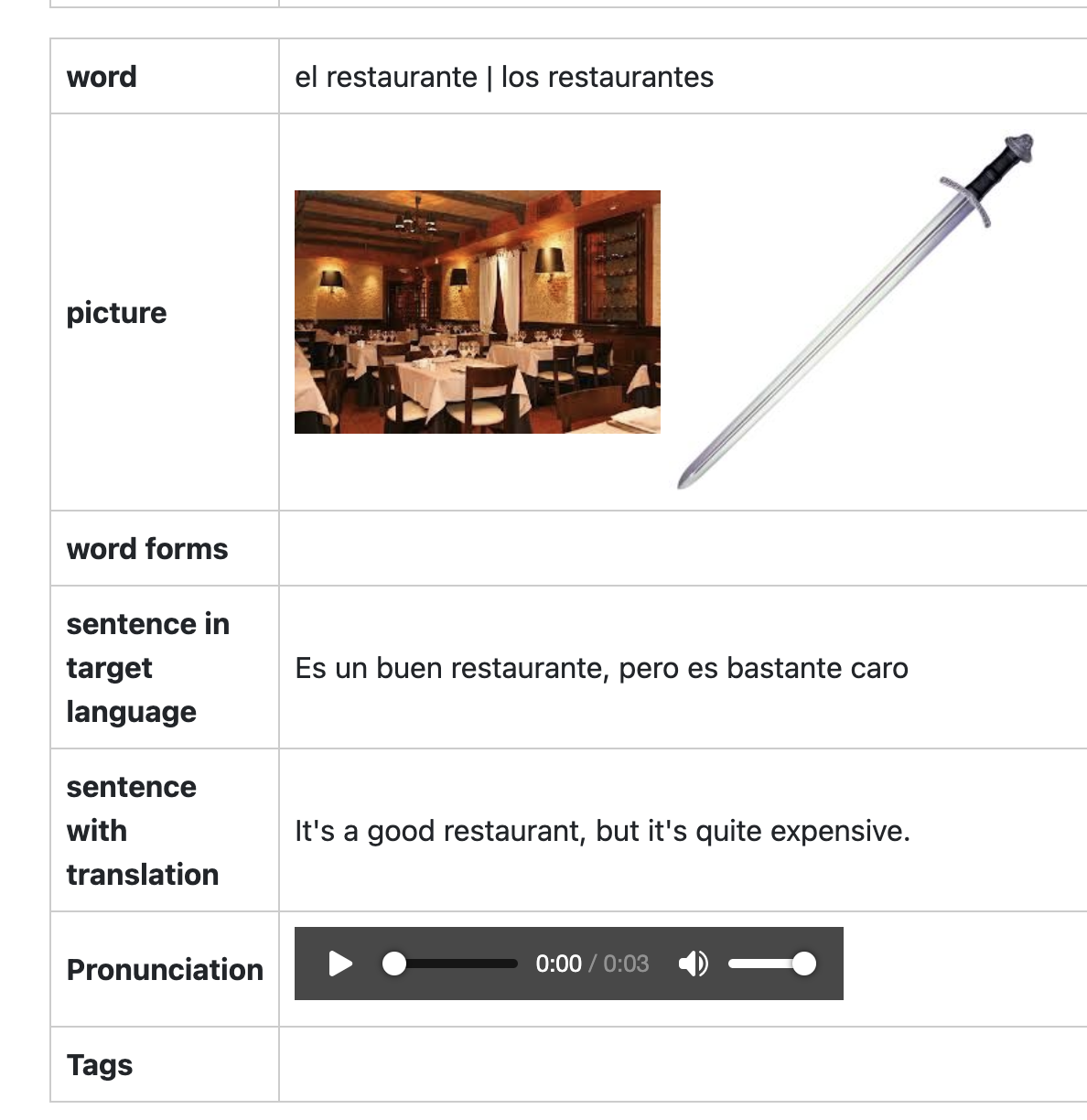
After you download and set up your deck, start practicing on it. The default is usually set to 20-25 new cards/words per day, but you can increase or decrease this to your liking. The goal is to spend around 30 minutes everyday acquiring new words and revising old ones.
How to go through a card
This is very important. Make sure to follow these steps exactly, otherwise you're not getting 100% value out of doing this everyday:
-
Look at the word (at first only the front of the card is shown to you). Try to remember the definition of the word. Don't spend more than 5-8 seconds trying to recall the definition.
-
Reveal the back of the card. If this is the first time seeing this word, look closely at the word and its definition, listen to the audio pronunciation and say it out loud a few times. Try to reproduce the sounds as accurately as you can. Don't spend too long here—you'll see the word again soon. Click the Again button and move on to the next card.
-
If you were able to recall the word immediately (within 1 second), click on Easy. If it took you 2-3 seconds, click Good.
-
If you were able to recall the word eventually, but it took a lot of hard thinking to get there, click on Hard. Now look at the definition and say the sample phrase out loud to yourself.
-
If you couldn't recall the word at all, go through the entirety of the card again like in step 2, and click on Again.

It's important here to be very honest with yourself. If you lie to the software, it's going to assume you know the word better than you do, and you will never end up learning it fully. Be harsh and truthful with the options.
Help with setting up Anki
You can read this post for more detailed instructions on setting up Anki. I'm aware that Anki isn't the most user-friendly software out there, and the number of options and settings can seem super intimidating when you're first getting started. This is okay, here's a short Youtube video that should help you get comfortable with the software.
While the default settings and algorithm should be good enough for most people, the folks over at Refold suggest changing the defaults. You can do so if you have the time or inclination.
Grammar
You can go a long way without doing any dedicated grammar learning; the intuitive parts of how the language works will simply click in your head. Sooner or later though, you'll find yourself asking why certain things don't follow the patterns you're used to seeing. This is when you should start doing grammar study.
There are a lot of ways to go about this, and I'd suggest picking the route that feels the least tedious, because staying consistent with grammar practice isn't the most fun thing in the world. Ideally, you should do one of the following for an hour or so, a few times a week. (If you're studying for a language test, you should probably do this daily, but for casual learners, a few sessions a week should suffice.)
- Pick up a grammar textbook: Look for one that's well-recommended. There are broadly two kinds: reference books, which give you cold hard facts about rules and exceptions, and coursebooks, which are intended to be more comprehensive and spoon-feed information slowly. I find the former easier and quicker to go through, as I find content designed to "engage" you can be terribly boring.
- Find grammar videos on YouTube: Look for videos that tackle one topic at a time. You can find a list of topics for your level from a textbook and then search for explanations and practice videos for that specific topic.
The goal here is to slowly work through topics in increasing order of difficulty—starting with sentence structures, verb conjugations, cases, and tenses. As long as you're doing new topics consistently, I wouldn't worry too much about planning months into the future. If you're a stickler for tracking progress, you can Google a "CEFR grammar checklist" and slowly tick off the things you've mastered. And take lots of notes!
Speaking
I'd suggest slowly starting to speak and engage in basic conversation a couple of months into your practice. You absolutely don't need a conversation partner to begin with. For 10–15 minutes a day, just practice saying phrases in your head, translating simple thoughts you're having.
For example, I used to spend parts of my commute to university just thinking up sentences in English and trying to say them in French. Along the way, I'd make mental notes of words I didn't know or structures I couldn't translate. When I got home, I'd look them up and say the corrected version out loud. The goal is to think in your TL as much as possible, which eventually makes speaking out loud much easier.
When you feel comfortable, seek out someone to practice with. This could be another learner, but I'd highly recommend someone with a higher level, ideally a native speaker. Making mistakes is natural, and you'll make fewer of them with practice. Ask your partner to correct you, and try to repeat the sentence with the corrections included until you get it right.
How to find speaking partners
- Language exchange websites/apps: You can find people who speak your TL and want to learn your native language on apps like Tandem, ConversationExchange, or iTalki (for paid lessons). In my experience, these can be hit-or-miss, but your luck may vary.
- Local communities: If you live in a larger city, try to find groups of speakers of your TL. See if there are meetups happening and try to make friends with native speakers. It's easier said than done, I know, but it helps immensely.
- The Cold Call Method: One unorthodox way I used to practice—I got a virtual phone number from France for very cheap and I'd call up local businesses to enquire about their services. I’d call a restaurant to ask if they had a table for ten, or a museum to ask about events. This works so well because the person on the other side has no idea you're a learner; they treat you like a native speaker and only respond in the TL! Just be sure not to waste their time—keep it under two minutes and don't actually book an appointment or anything that will make the life of the person on the other end harder.
Closing thoughts
Congrats on making it to the end! This should be enough to take you from complete beginner to intermediate level in your TL.
I didn't really want to write a conclusion, but ending abruptly felt wrong. When I started writing this, I just wanted to explain my language learning method. Looking back now, it reads more like an opinionated guide than I intended. Still, I hope there are bits and pieces here that help you on your own journey. All the best!